

BGP for Network Resilience: How It Ensures Business Continuity

When we talk about operational continuity within organizations, the conversation usually revolves around applications, cloud infrastructure, or cybersecurity. However, there is a critical element that is not always considered or included in executive discussions, and when it fails, it can lead to a complete operational shutdown: external network routing.
In this context, the Border Gateway Protocol (BGP) becomes one of the fundamental—yet often invisible—pillars of enterprise resilience in modern organizations.
For companies that rely entirely on constant connectivity, global presence, or any type of digital service, understanding the strategic role of BGP is essential. It is crucial for ensuring availability, optimizing traffic, and mitigating operational risks.
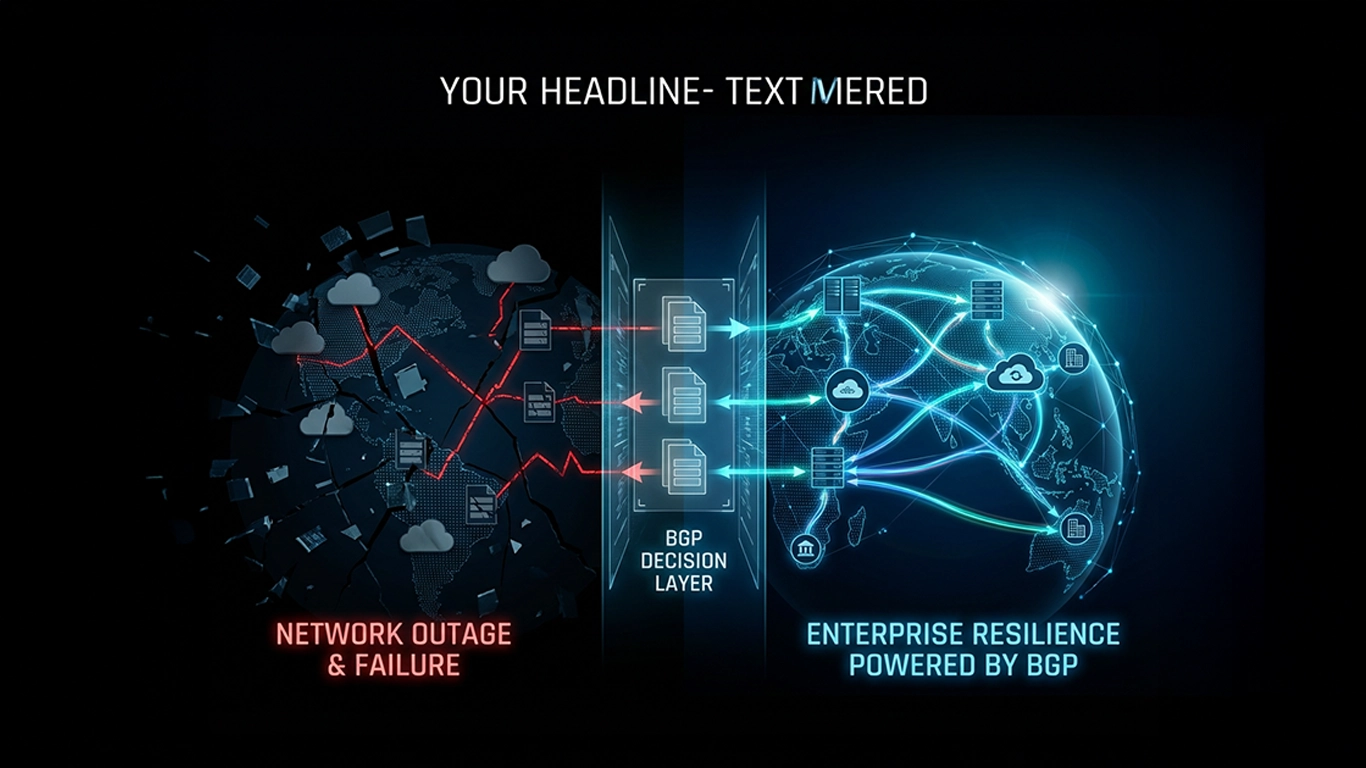
The real importance of BGP in modern organizations
BGP is the protocol that allows networks to exchange routing information globally. In other words, it determines how internet traffic travels. However, for modern enterprises, its role goes far beyond simple connectivity. It directly impacts:
- Customer experience across digital platforms
- Availability of critical services
- Access to cloud applications
- Resilience in case of provider connectivity failures
- Operational continuity across locations and regions
If an organization relies on a single internet provider or lacks an intelligent routing strategy, even a minor external disruption could result in a complete business outage. This is where BGP becomes fundamental, preventing such scenarios.

The real problem: connected infrastructures that are not resilient
Some organizations have invested in hardware redundancy, virtualization, and cloud environments. However, they still operate with basic connectivity schemes, such as:
- A single internet provider
- No traffic optimization policies
- Limited control over outbound routes
- Manual or limited failover
In this scenario, the network may appear robust internally, but in reality, it remains externally vulnerable. From an executive perspective, this creates a false sense of security. It is important to note that the most critical disruptions typically occur at the external interconnection level, not within the data center.

How BGP transforms enterprise connectivity
Proper BGP implementation provides several advantages. Below are the three most important:
1. Multi-homing
One of the key benefits of BGP is the ability to work with multiple internet service providers (ISPs). This ensures operational continuity without manual intervention, significantly reduces downtime risk, and provides automatic redundancy in case of provider failures.
From an executive standpoint, this translates into eliminating single points of failure in connectivity—ensuring total reliability.
2. Resilience against global failures
The internet is not a perfect network. Providers may fail, congestion can occur, or routing issues may impact entire regions. With a BGP architecture, organizations can dynamically adapt to these situations by automatically redirecting traffic through available routes. For organizations with distributed or international operations, this is especially critical.
3. Traffic engineering
Beyond redundancy, BGP provides direct control over traffic flow. Organizations can balance loads across multiple links, prioritize more efficient routes, reduce latency in cloud services, and optimize access to critical applications.
All of this has a direct impact on operational efficiency and user experience.
The advantage of BGP in the cloud and multicloud era
Today, organizations operate in cloud and multicloud environments, transforming how infrastructure is consumed. Many operate in:
- Hybrid environments
- Multicloud setups
- Geographically distributed architectures
In this context, BGP plays a key role in:
- Ensuring optimal routes to applications
- Guaranteeing availability of critical services
- Maintaining consistent network policies
- Efficiently interconnecting environments
Without a proper routing strategy, cloud performance can be significantly affected by latency, suboptimal routing, or unnecessary dependencies.
The importance of proper implementation
While BGP is highly valuable, it is also a complex protocol that requires expert design and configuration. Poor implementation can lead to:
- Intermittent outages
- Loss of control over inbound and outbound traffic
- Exposure to route hijacking (BGP hijacking)
- Route instability
Unfortunately, these risks are often not visible until they directly impact operations. For this reason, BGP management must evolve from a standard configuration into a specialized discipline within network architecture.

The importance of well-designed architecture and expertise
Implementing BGP correctly goes beyond simply enabling the protocol. It requires a comprehensive approach that considers network topology, connectivity providers, future growth, security policies, and cloud strategies.
Organizations that approach BGP strategically achieve more robust, predictable, and scalable infrastructures.
Beyond technical knowledge, real-world experience is essential. It is necessary to understand how routing impacts operations, user experience, and business continuity.
Organizations like JT Tech Global, with experience in designing and implementing complex enterprise networks, become strategic partners. They help businesses turn BGP into a strategic asset, reducing risks and improving overall infrastructure performance.
Conclusion
BGP is rarely featured in executive reports and often goes unnoticed, yet it supports a significant portion of modern digital operations.
Investing early in a robust, secure, and optimized routing architecture is not a luxury—it is a strategic decision that directly impacts organizational resilience.
Por JT Tech
IT Solutions – WiFi
Related Resources

Extreme Networks for Sports & Entertainment Venues
Extreme Networks offers a range of networking solutions that can help enhance the fan experience, increase engagement and revenue, improve operations, reduce operational risk and differentiate sports and entertainment venues from competitors.Here are some ways Extreme...

GLR College Delivers Extreme Solutions for Creative Minds
The Grafisch Lyceum Rotterdam (GLR) is the Benelux region’s largest and most innovative creative college for media, design, and technology. With over 400 staff members, educators, and more than 4,000 students the GLR offers a broad range of college-level programs that...

City, University of London Modernizes Wireless Campus Infrastructure
Founded in 1894, City, University of London is a leading international institute recognized for its high rank in student satisfaction. In partnership with Extreme and Charterhouse Group, City, University of London was able to eliminate downtime, access unprecedented...