

Enterprise Networks in Multicloud Environments: Common Mistakes That Compromise Security, Costs, and Performance

Multicloud and Enterprise Networks: Hidden Risks That Could Impact Business Operations
Over the past few years, multicloud adoption has evolved from a technological initiative into a strategic business decision. Organizations across industries now leverage multiple cloud providers to gain geographic proximity, flexibility, cost optimization, and to avoid excessive dependency on a single vendor.
However, many organizations overlook a critical reality: without a well-designed multicloud network strategy, what seems like an advantage can quickly become a source of operational risk, performance degradation, and unexpected costs.
For executive leadership, the challenge is no longer whether to adopt multicloud — but how to implement it without jeopardizing security, financial efficiency, and business continuity. This is where the enterprise network becomes mission-critical.
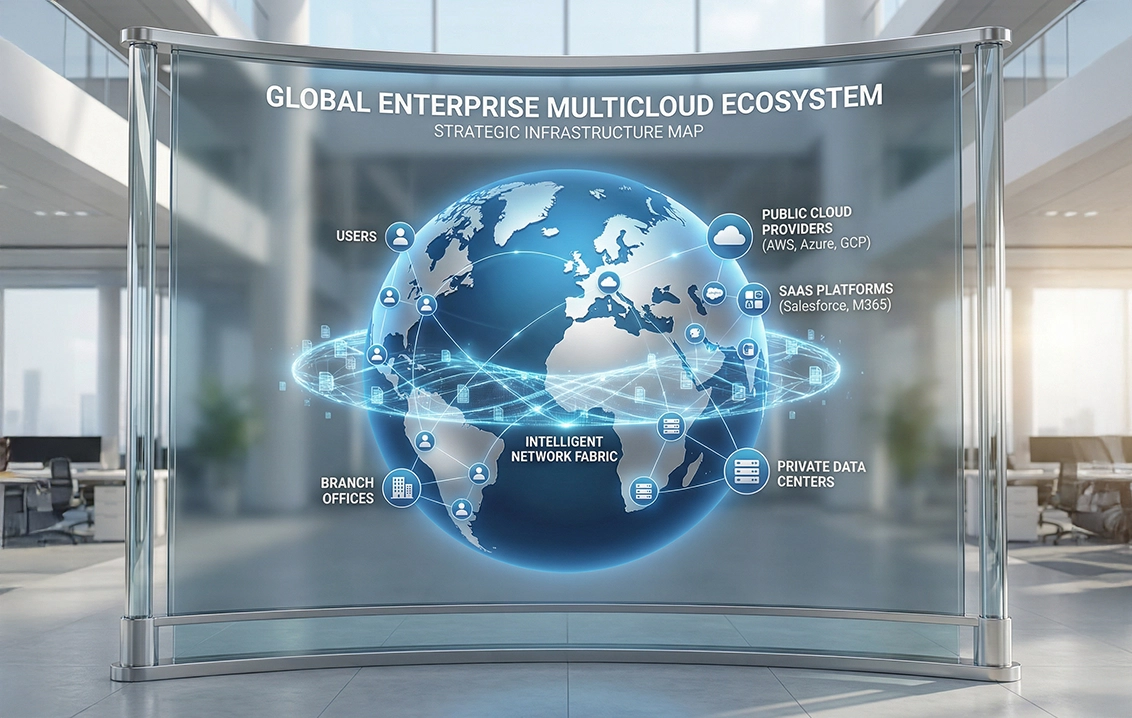
The Network in Modern Multicloud Architectures
In traditional IT environments, the network connected users to applications hosted in a centralized data center. In today’s multicloud model, the network has evolved into a distributed ecosystem that includes:
-
Remote users and distributed branch offices
-
Multiple public cloud providers
-
Critical SaaS applications
-
Private and public interconnections between environments
-
On-premises data centers
In this new reality, the network is no longer a passive connector — it is an active enabler of the multicloud strategy. Failing to recognize this shift early often leads to structural design errors that negatively impact business performance.
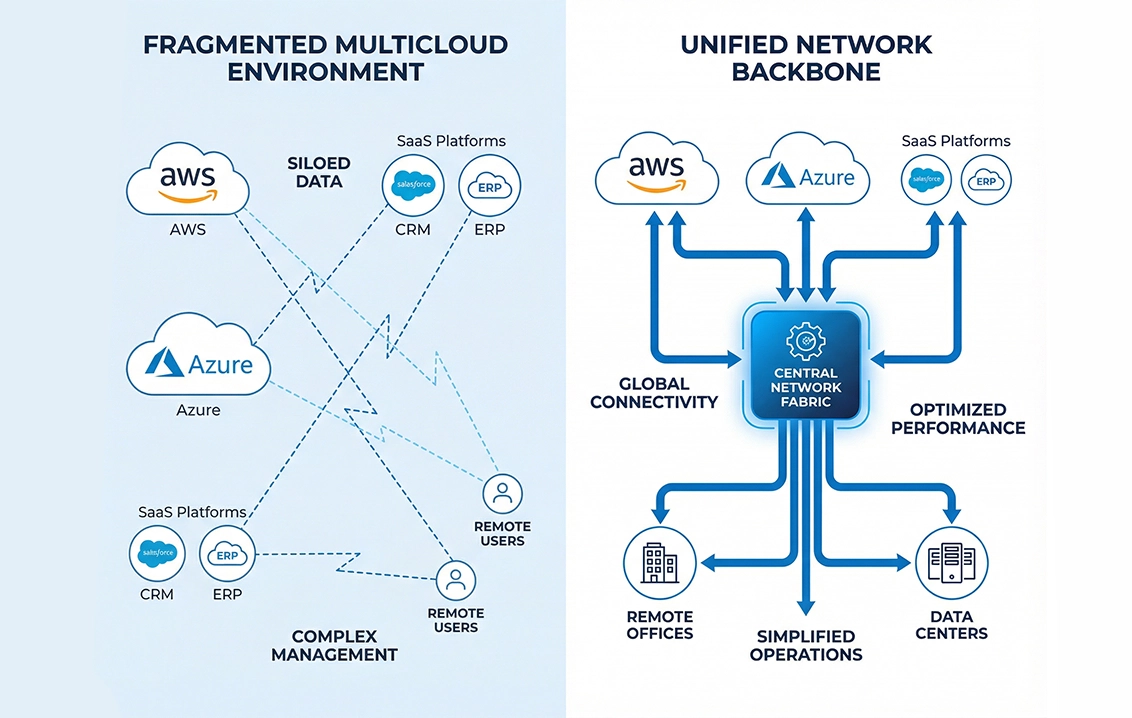
Mistake #1: Lack of a Unified Network Architecture
One of the most common mistakes is treating each cloud provider as an isolated environment. Organizations deploy AWS for one workload, Azure for another, and manage them independently based on immediate needs.
This fragmented approach often results in:
-
Inconsistent or unstable connectivity
-
Disjointed architectures
-
Complex interdependencies
-
Lack of standardized security and operational policies
For executives, this translates into greater risk, higher complexity, and reduced visibility.
A mature and effective multicloud strategy begins with a unified network architecture — designed from the ground up to support multiple environments while maintaining consistency and control.
Organizations that achieve multicloud maturity understand that the network cannot be retrofitted later. It must be designed as the backbone of the entire operating model.
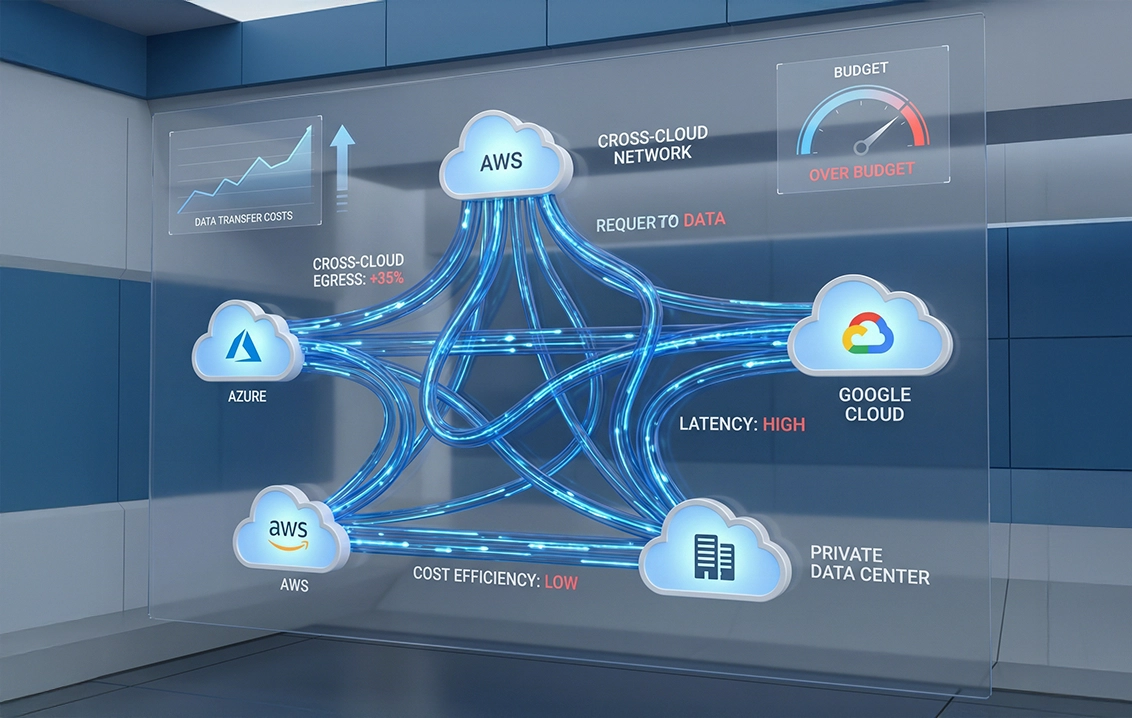
Mistake #2: Ignoring Network Costs in Multicloud Financial Planning
Cost optimization is one of the primary drivers behind multicloud adoption. Yet many organizations experience the opposite outcome: rising and unpredictable expenses.
Failing to account for network-related costs often leads to:
-
Inefficient routing
-
Excessive inter-cloud data transfer fees
-
Poor traffic engineering
-
Limited visibility into consumption patterns
When the network architecture is not strategically designed, multicloud environments lose financial predictability and become increasingly complex to manage.
For finance and operations teams, cost volatility is often a red flag that the network design is misaligned with broader business objectives.

Mistake #3: Limited End-to-End Observability Across Multicloud Environments
Another frequent oversight is the absence of holistic visibility across the entire ecosystem. Managing multicloud environments with siloed tools from different providers results in fragmented monitoring and incomplete insights.
Comprehensive cross-environment observability enables organizations to:
-
Detect issues before they impact the business
-
Identify root causes quickly
-
Make informed, data-driven decisions
-
Reduce dependency on individual cloud providers
Today, network observability in multicloud environments is not a technical luxury — it is a strategic necessity at the executive level. It provides clarity into how environments interact and how they influence overall business outcomes.

Mistake #4: Underestimating Network Performance as a Business-Critical Factor
In multicloud environments, network performance directly impacts:
-
Availability of mission-critical applications
-
SLA compliance
-
Internal productivity and operational efficiency
-
Customer experience
Many organizations assume that “cloud performance is always reliable.” In reality, latency, jitter, and packet loss between cloud environments can significantly degrade application performance — even if each individual component is functioning correctly.
The impact is rarely immediate. It often manifests as slower processes, dissatisfied customers, frustrated operational teams, and business decisions based on incomplete or delayed data.
Once again, the network becomes an invisible yet invaluable asset.

Mistake #5: Relying on Providers Without a Strategic Vision
The market is saturated with multicloud vendors offering advanced technologies. However, many focus only on solving immediate technical issues or isolated projects.
While this may address short-term needs, it often leads to globally misaligned solutions.
Organizations need a strategic partner capable of:
-
Understanding the business model
-
Designing the network architecture as an integrated ecosystem
-
Anticipating operational and financial risks
-
Supporting the evolution of the multicloud environment
-
Translating technical complexity into measurable business impact
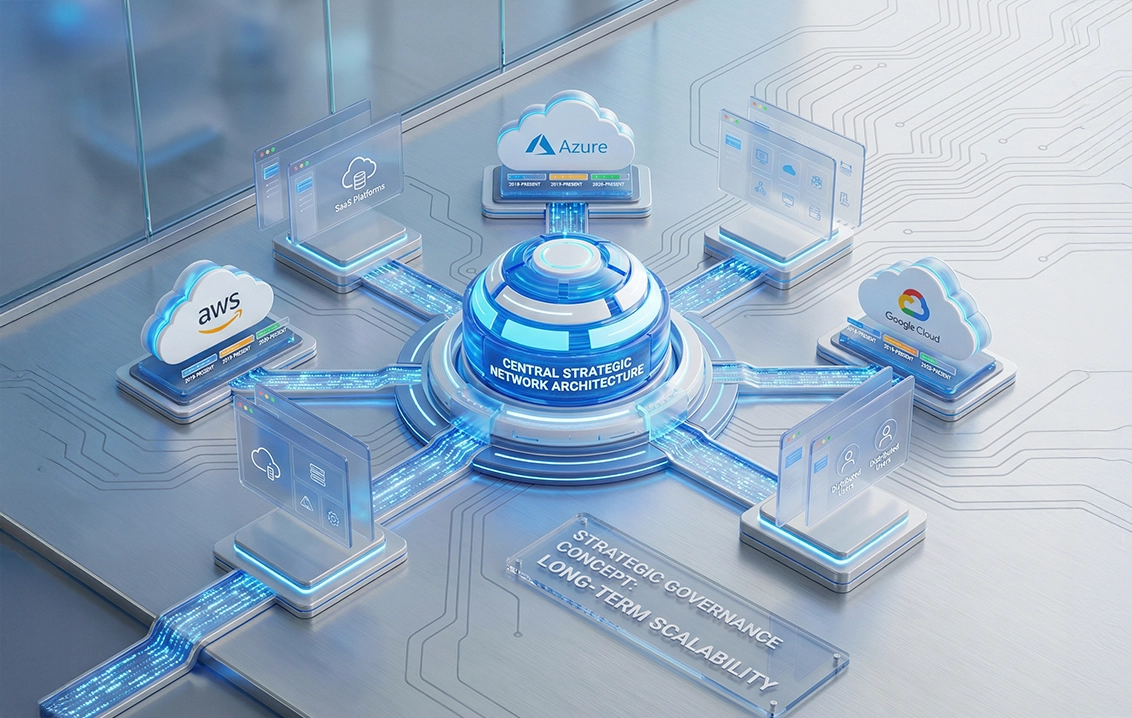
JT Tech: More Than a Provider — A Strategic Advisor
With operations in both Colombia and the United States, JT Tech supports enterprise organizations across industries in the adoption and optimization of multicloud environments where the network plays a critical role.
JT Tech’s approach goes beyond implementing cutting-edge technology. The process begins with a deep understanding of each organization’s business objectives, growth plans, and risk landscape.
Through advanced observability, thoughtfully engineered architectures, and a long-term strategic vision, JT Tech helps organizations:
-
Align network strategy with business objectives
-
Reduce operational risk
-
Ensure consistent performance for mission-critical applications
-
Simplify complexity without sacrificing control
-
Optimize connectivity and operational costs
By combining technical expertise with strategic business alignment, JT Tech becomes a trusted advisor to executive leadership — enabling confident decision-making and ensuring that network infrastructure evolves alongside the company’s digital transformation journey.
Por JT Tech
IT Solutions – WiFi
Related Resources

Extreme Networks for Sports & Entertainment Venues
Extreme Networks offers a range of networking solutions that can help enhance the fan experience, increase engagement and revenue, improve operations, reduce operational risk and differentiate sports and entertainment venues from competitors.Here are some ways Extreme...

GLR College Delivers Extreme Solutions for Creative Minds
The Grafisch Lyceum Rotterdam (GLR) is the Benelux region’s largest and most innovative creative college for media, design, and technology. With over 400 staff members, educators, and more than 4,000 students the GLR offers a broad range of college-level programs that...

City, University of London Modernizes Wireless Campus Infrastructure
Founded in 1894, City, University of London is a leading international institute recognized for its high rank in student satisfaction. In partnership with Extreme and Charterhouse Group, City, University of London was able to eliminate downtime, access unprecedented...